Collision regulations
All boats using the waterways must thoroughly understand and apply the International Regulations for Preventing Collisions at Sea (Colregs).
Make your intentions clear
Actions must be clear and deliberate so other skippers can see your intentions. Never assume the operator of another boat will observe the rules. Always be prepared to take action to avoid a collision.
Keep a proper lookout
A good lookout through sight and sound must be kept at all times. Be aware of the boating environment and take extra precautions in bad weather, restricted visibility and darkness to assist with the early detection of other boats in the area.
Restricted visibility
All boats should use sound signals in restricted visibility to alert others of their position. Use common sense and slow your boat or stop and be ready to take immediate action. Be extremely cautious when operating in restricted visibility.
Sound signals
Most recreational boats do not use sound signals. However, they are used by commercial ships and larger vessels. Boats more than 12 metres should carry sound signals, a whistle and a bell. Boats under 12 metres should have some means for making an efficient sound signal.
You should be aware of sound signals and what action you should take when you hear a sound signal. Sound signals may be accompanied by light signals.
One short blast means 'I am altering my course to starboard'.
Two short blasts means 'I am altering my course to port'.
Three short blasts means 'I am operating engines astern' (the boat may be reversing or stopping).
Five (or more) short blasts means 'I am unsure of your intentions'.
Assess risk of collision and take action
Use all means available to assess whether other boats pose a risk of collision. If a risk of collision exists, early positive action (changing course and/or speed) must be taken to eliminate the risk.
Collision rules
The Colregs give clear indication about passing, approaching, giving way and overtaking to avoid collisions with other boats. They are the traffic laws on the water.
| Rivers and channels A boat must always be navigated on the starboard side (right) of a river or channel. |
 |
| Approaching head on to another boat Each boat alters course to starboard (right) and passes port to port (left). Always assume this situation exists. |
 |
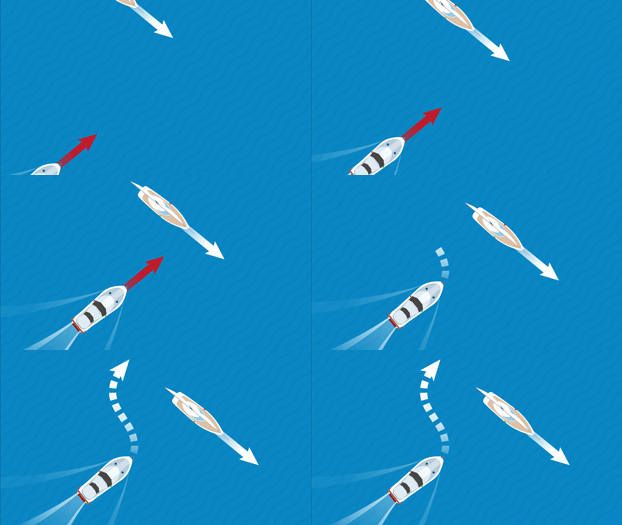
| Power-driven boats crossing A boat approaching from your starboard (right) side has right of way. If you are approaching another boat from its starboard side, you have right of way. However, if the other boat does not give way, you must take action to avoid a collision. |
 |
| Overtaking If you are overtaking a boat, you can do so at either side of the boat you wish to pass. However, you must keep well clear of the boat you are overtaking. This applies to both sail and power boats. |
 |
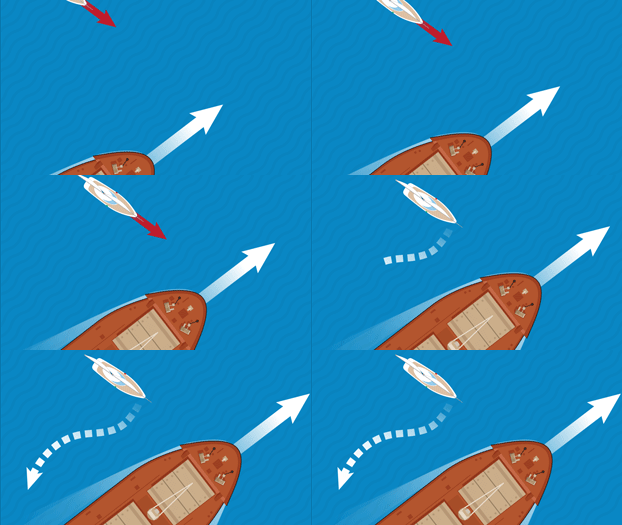
| Sailing boats and power-driven boats Power usually gives way to sail. However, this does not always apply. Larger vessels, such as ferries or container ships, have difficulty manoeuvring due to their size. Masters of other boats, including sail boats, should always apply common sense and good seamanship by giving larger vessels a wide berth. |
|
| Sailing boats When two sailing boats have wind on different sides, the boat with the wind on the port side must give way. When both boats have the wind on the same side, the boat to windward shall give way to the boat to leeward. |
 |